Le bacteriophage dans l’organisme. Note by R. Appelmans, presented by R. Bruynoghe. Comptes Rendus de l’Académie des Sciences, 1921, 85:722-724, a Claude.ai Translation

THE BACTERIOPHAGE IN THE ORGANISM.

Note by R. Appelmans, presented by R. Bruynoghe.

Methods:

The article was scanned and OCRed using French as the recognition language. The OCRed text was then corrected as needed (as shown in gray). The corrected text was then translated by Claude.ai, which prior to that point was not involved in the effort. Claude.ai was then asked to generate an abstract-style narrative summary (which was then corrected manually as appropriate) and then an assessment of precedence  that might be claimed by the work.

Summary by Claude.ai:

This research by R. Appelmans investigated the fate of bacteriophage in animal organisms as part of studies on its therapeutic value. Using guinea pigs and mice, the authors examined bacteriophage behavior following both oral and injectable administration, employing a functional detection method in which organ samples or excreta were added to broth, heated to 56°C to inactivate bacteria while preserving phage, then inoculated with susceptible microbes to detect growth inhibition.

When bacteriophage mixed with bread was given orally to animals, the bacteriophages appeared regularly in feces for several days, persisting longer when susceptible gut microbes were present for it to parasitize. The phage’s resistance to acids and enzymes explained its survival through the digestive tract. However, examination of internal organs revealed no bacteriophage penetration across the intestinal mucosa, a finding the authors attributed to the principle’s inability to dialyze, suggesting it could not pass through biological membranes.

In contrast, injected bacteriophage rapidly entered the bloodstream in accordance with earlier findings by Bordet and Ciuca. However, its presence in blood was brief, as it was progressively eliminated through the kidneys and intestines, disappearing completely within 24 to 48 hours depending on dose, with no traces detected after five days. Notably, the spleen retained substantial quantities of bacteriophage even when it had been cleared from other organs, a phenomenon the authors connected to the spleen’s known role in retaining microbes during infections. This splenic persistence was temporary; after fifteen days, no bacteriophage remained, which the authors attributed to neutralization by antibacteriophage antibodies that form in the organism, as demonstrated by Bordet, Ciuca, and Maisin. The authors emphasized that the bacteriophage detected in organs was not produced by organ-induced bacterial modification as Bordet’s theory might suggest, since control experiments with normal organs or organs from bacteriophage-fed animals never yielded bacteriophage in cultures of susceptible bacteria.

Translation by Claude.ai:

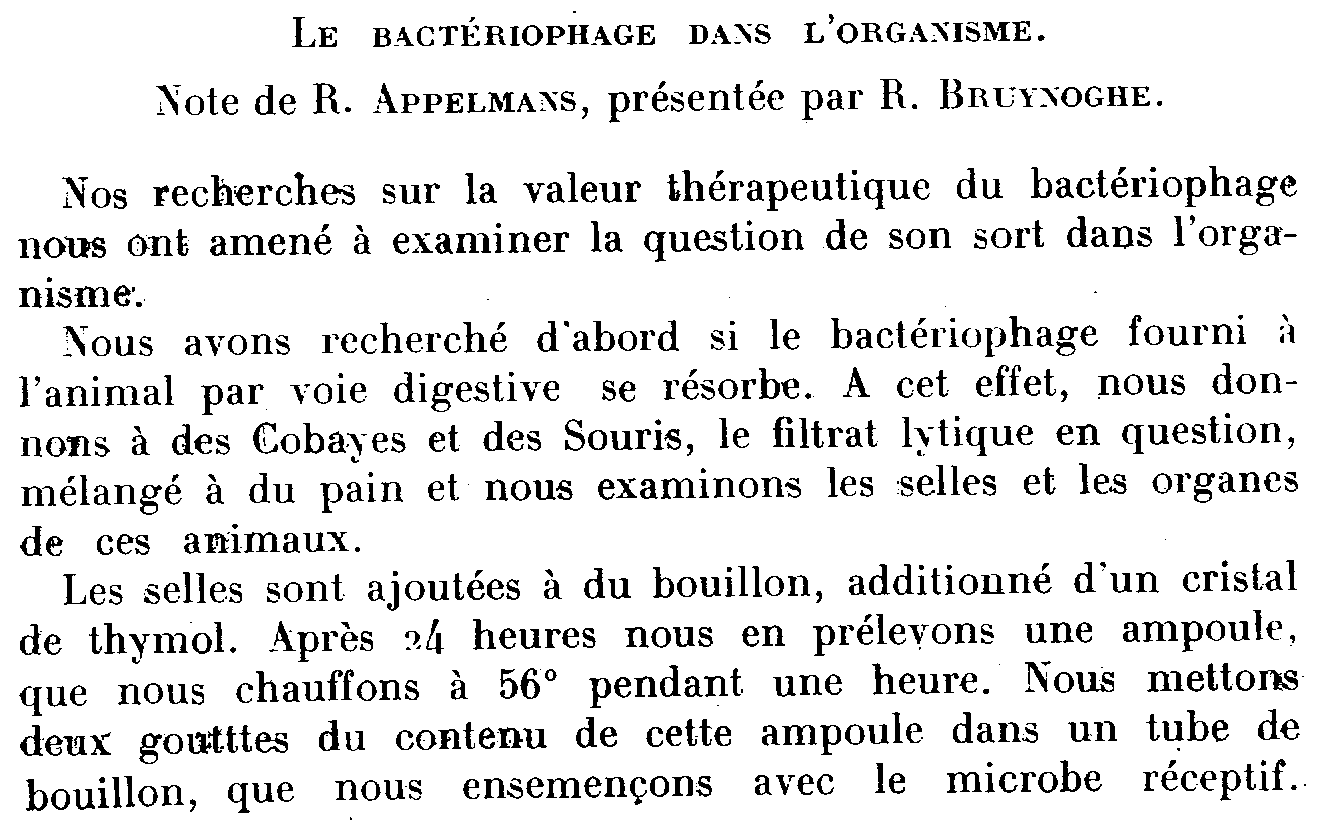
Our research on the therapeutic value of bacteriophage has led us to examine the question of its fate in the organism.

We first investigated whether the bacteriophage supplied to the animal by the digestive route is absorbed. For this purpose, we give guinea pigs and mice the lytic filtrate in question, mixed with bread, and we examine the feces and organs of these animals.

The feces are added to broth, supplemented with a crystal of thymol. After 24 hours we take an ampoule of it, which we heat to 56° for one hour. We place two drops of the contents of this ampoule in a tube of broth, which we inoculate with the receptive microbe.

(Note from claude.ai: “’Réceptif’ (receptive) refers to a bacterial strain susceptible to the particular phage being tested, which is standard terminology for this period.”)

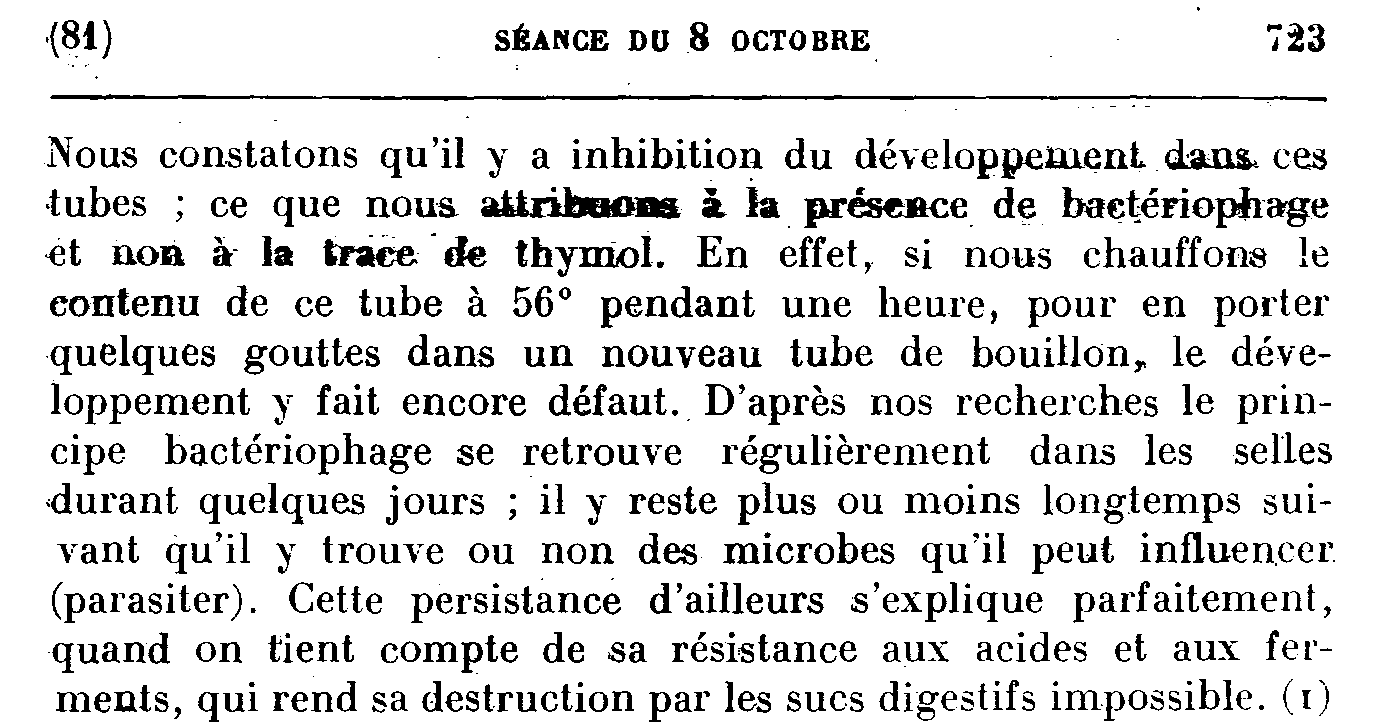
We observe that there is inhibition of growth in these tubes; which we attribute to the presence of bacteriophage and not to the trace of thymol. Indeed, if we heat the contents of this tube to 56° for one hour, to transfer a few drops into a new tube of broth, growth is still absent. According to our research, the bacteriophage principle is regularly found in the feces for several days; it remains there for a longer or shorter time depending on whether or not it finds microbes that it can influence (parasitize). This persistence, moreover, is perfectly explained when one takes into account its resistance to acids and to enzymes, which makes its destruction by digestive juices impossible. (1)

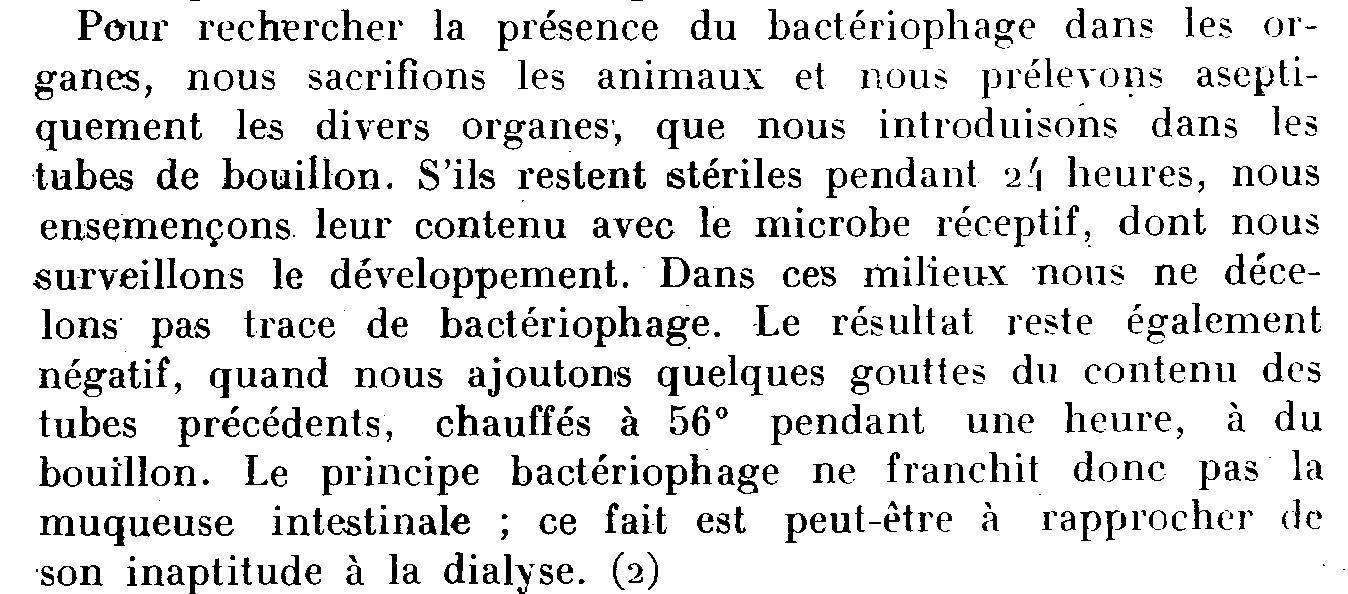
To search for the presence of bacteriophage in the organs, we sacrifice the animals and we aseptically remove the various organs, which we introduce into tubes of broth. If they remain sterile for 24 hours, we inoculate their contents with the receptive microbe, whose growth we monitor. In these media we detect no trace of bacteriophage. The result also remains negative when we add a few drops of the contents of the preceding tubes, heated to 56° for one hour, to broth. The bacteriophage principle therefore does not cross the intestinal mucosa; this fact is perhaps to be related to its inability to dialyze. (2)

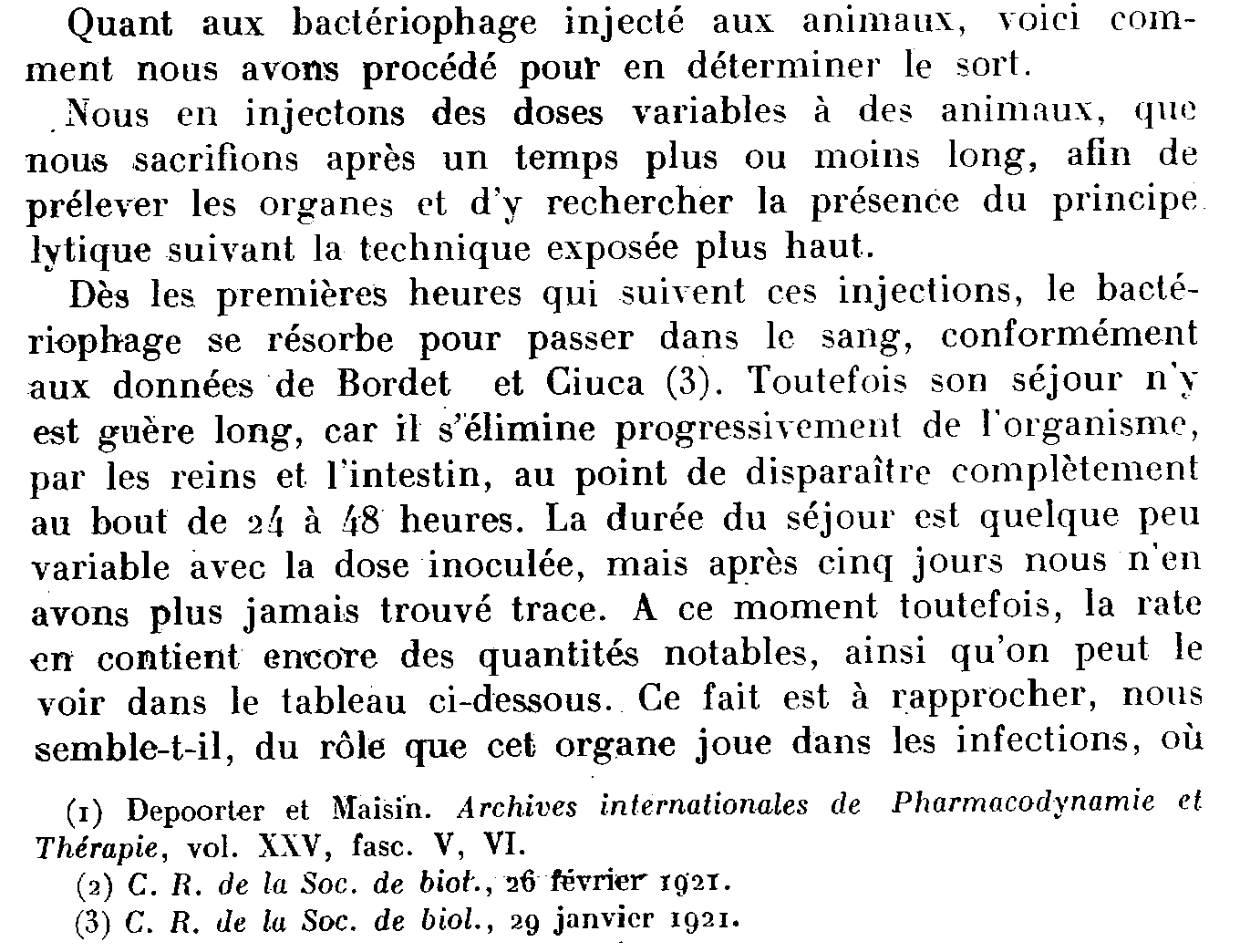
As for the bacteriophage injected into animals, here is how we proceeded to determine its fate.

We inject variable doses of it into animals, which we sacrifice after a longer or shorter time, in order to remove the organs and to search in them for the presence of the lytic principle following the technique described above.

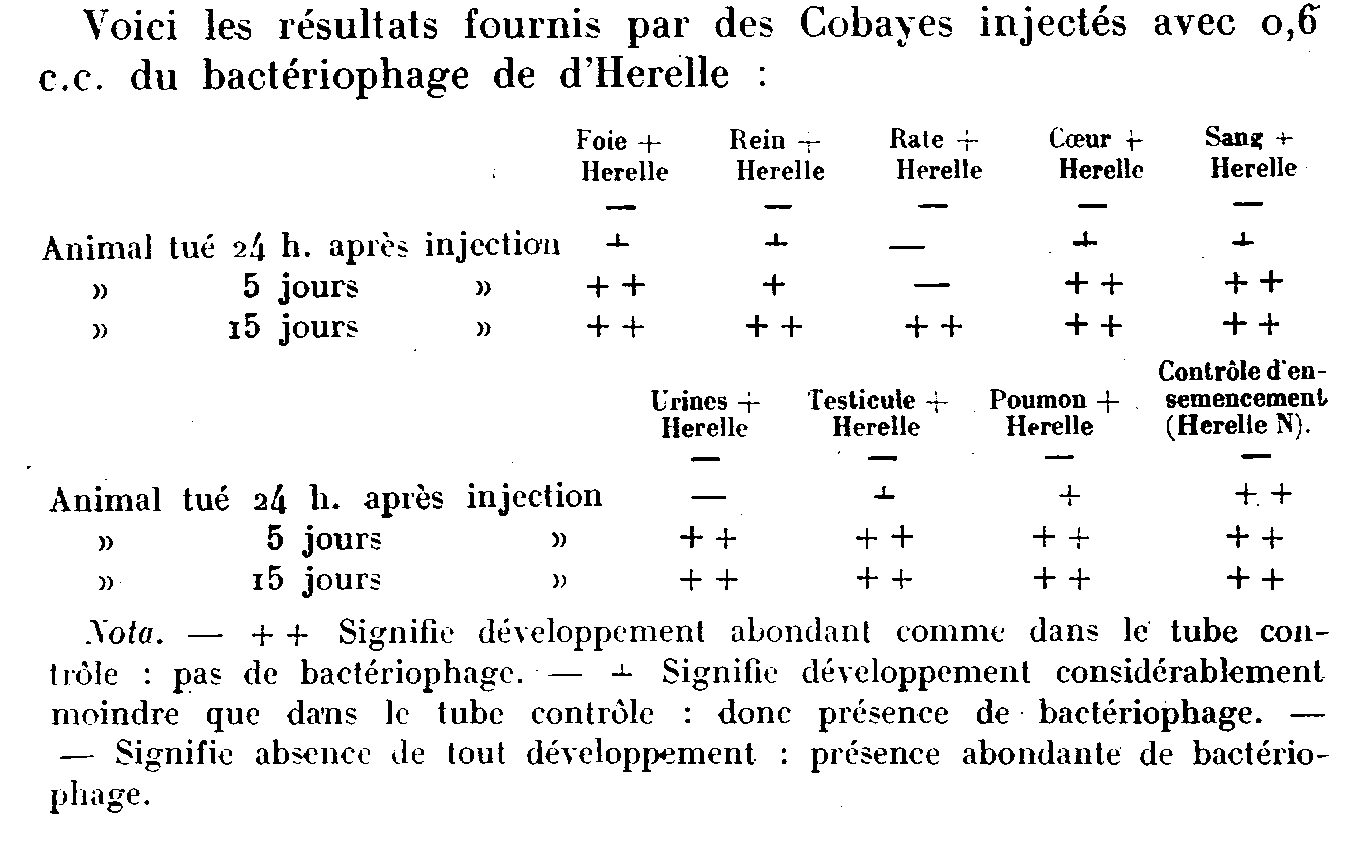
From the first hours following these injections, the bacteriophage is absorbed to pass into the blood, in accordance with the data of Bordet and Ciuca (3). However, its stay there is hardly long, for it is progressively eliminated from the organism, by the kidneys and the intestine, to the point of disappearing completely after 24 to 48 hours. The duration of stay varies somewhat with the inoculated dose, but after five days we have never found any trace of it. At this moment however, the spleen still contains notable quantities of it, as can be seen in the table below. This fact is to be related, it seems to us, to the role that this organ plays in infections, where…

(1) Depoorter and Maisin. Archives internationales de Pharmacodynamie et Thérapie, vol. XXV, fasc. V, VI.

(2) C. R. de la Soc. de biol., 26 January 1921.

(3) C. R. de la Soc. de biol., 29 January 1921

…it also intervenes actively to retain the microbes. In the spleen, however, the bacteriophage does not persist, given that fifteen days later, it is completely devoid of it. At this moment, the disappearance results, in our opinion, from the neutralization brought about by the antibacteriophage that forms in the organism, as shown by the experiments of Bordet, Ciuca and Maisin.

Here are the results provided by guinea pigs injected with 0.6 c.c. of d’Herelle’s bacteriophage: [see table image below]

[Table words:] Liver (Foie), Kidney (Rein), Spleen (Rate), Heart (Coeur), Blood (Sang), killed (tué), Urine (Urines), Testicle (Testicule), Lung (Poumon), Inoculation control (Contrôle d’ensemencement).

[Table footnote:] Note. – + + Signifies abundant growth as in the control tube: no bacteriophage. – + Signifies considerably less growth than in the control tube: therefore presence of bacteriophage. – Signifies absence of all growth: abundant presence of bacteriophage.
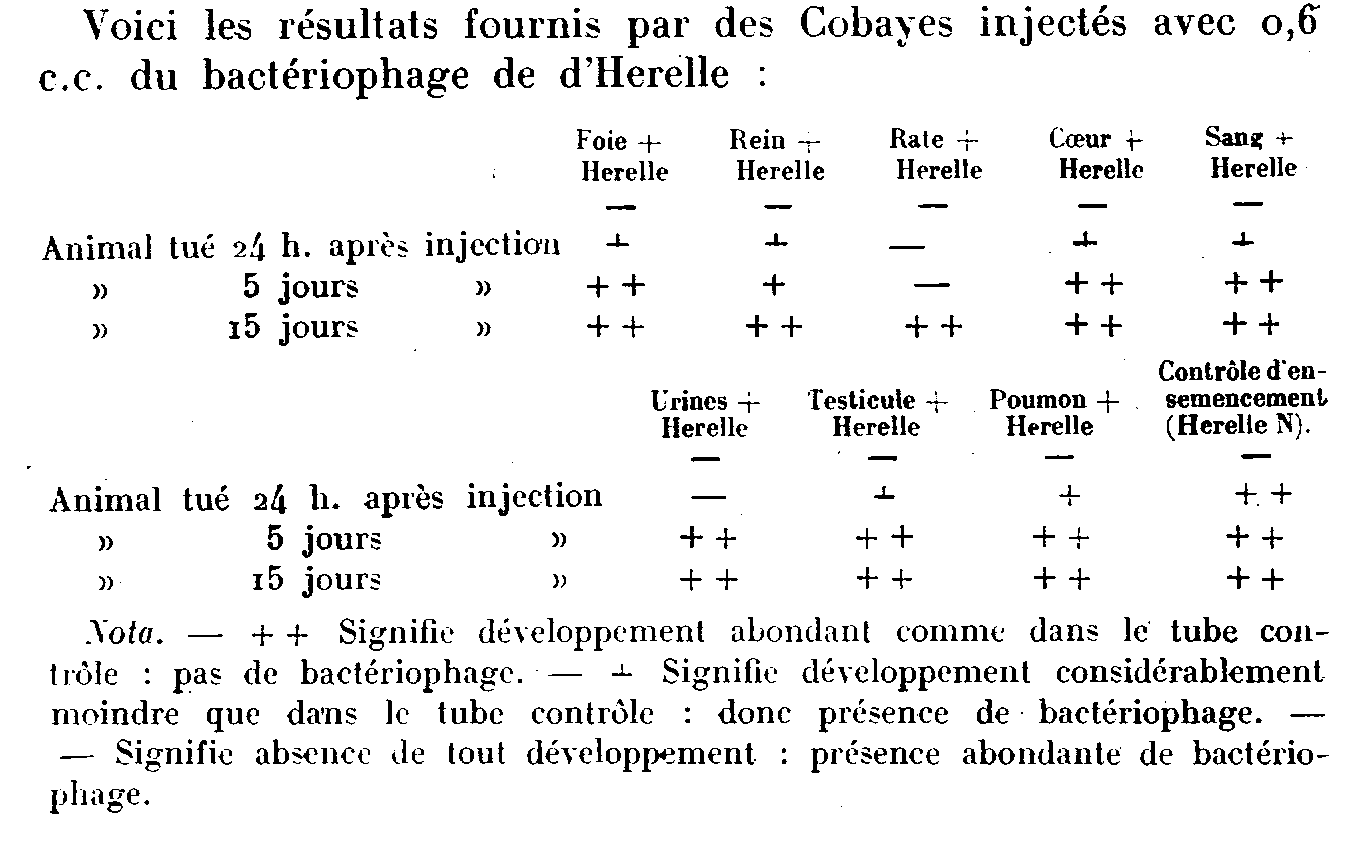
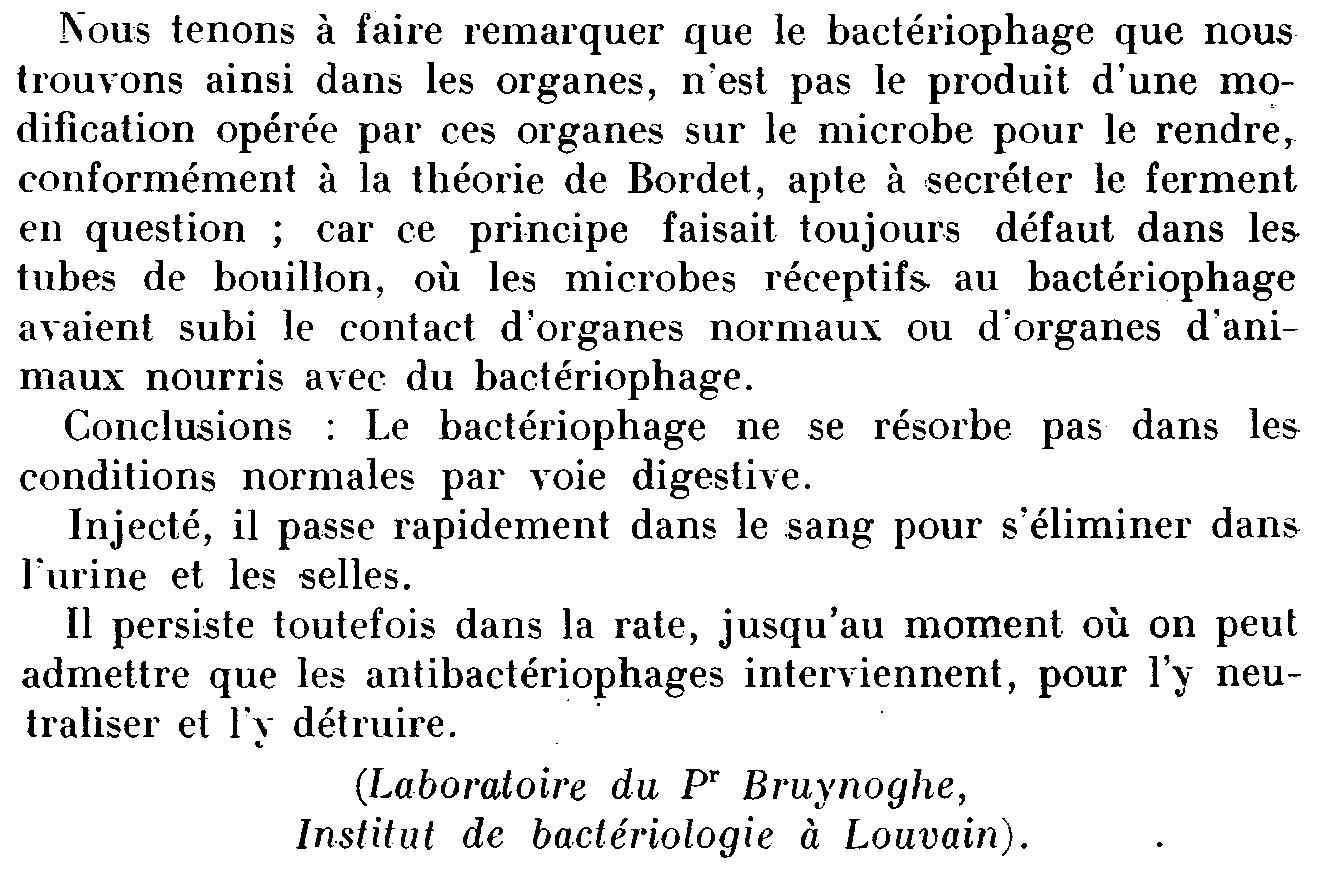
We wish to point out that the bacteriophage that we thus find in the organs is not the product of a modification operated by these organs on the microbe to make it, in accordance with Bordet’s theory, capable of secreting the ferment in question; for this principle was always absent in the tubes of broth, where the microbes receptive to the bacteriophage had undergone contact with normal organs or with organs of animals fed with bacteriophage.

Conclusions: The bacteriophage is not absorbed under normal conditions by the digestive route.

When injected, it passes rapidly into the blood to be eliminated in the urine and feces.

It persists however in the spleen, until the moment when one can admit that the antibacteriophages intervene, to neutralize and destroy it there.

Possible Precedence as suggested by Claude.ai:

[Note: This assessment of precedence is based on the document itself and may not reflect comprehensive historical research.]

This article appears to be an important early systematic study of bacteriophage pharmacokinetics and biodistribution – essentially asking “what happens to phage when you put it in an animal body?” This was a critical question for the therapeutic use of bacteriophage, which was being actively explored in the early 1920s.

Several aspects suggest precedence or importance:

  • Oral vs. Injectable Routes: The finding that orally administered phage does NOT cross the intestinal barrier was significant for therapeutic applications. This would have important implications for how phage therapy should be administered.
  • First Detailed Tracking Study: While the authors cite Bordet and Ciuca (1921) for the observation that injected phage enters the blood, Appelmans appears to provide the first detailed tracking of phage through multiple organs over time, including the kinetics of elimination.
  • Splenic Sequestration: The observation that the spleen retains phage longer than other organs was novel and connected phage behavior to the spleen’s known immunological functions.
  • Antibody Neutralization: Linking the disappearance of phage from the spleen to antibacteriophage (neutralizing antibodies) helped establish that the immune system recognizes and responds to phage as foreign material.

The dates are telling: the references are from January 1921, suggesting this work was conducted very shortly after (or contemporaneously with) Bordet’s group’s initial observations. Given that Félix d’Herelle only clearly described bacteriophage in 1917, this 1921 work represents research within just a few years of phage discovery, making it part of the foundational literature on phage biology and a key early study informing phage therapy attempts.

OCR Work and Resulting Translation:

Our research on the therapeutic value of bacteriophage has led us to examine the question of its fate in the organism.

We first investigated whether the bacteriophage supplied to the animal by the digestive route is absorbed. For this purpose, we give guinea pigs and mice the lytic filtrate in question, mixed with bread, and we examine the feces and organs of these animals.

The feces are added to broth, supplemented with a crystal of thymol. After 24 hours we take an ampoule of it, which we heat to 56° for one hour. We place two drops of the contents of this ampoule in a tube of broth, which we inoculate with the receptive microbe.

(Note from claude.ai: “’Réceptif’ (receptive) refers to a bacterial strain susceptible to the particular phage being tested, which is standard terminology for this period.”)

We observe that there is inhibition of growth in these tubes; which we attribute to the presence of bacteriophage and not to the trace of thymol. Indeed, if we heat the contents of this tube to 56° for one hour, to transfer a few drops into a new tube of broth, growth is still absent. According to our research, the bacteriophage principle is regularly found in the feces for several days; it remains there for a longer or shorter time depending on whether or not it finds microbes that it can influence (parasitize). This persistence, moreover, is perfectly explained when one takes into account its resistance to acids and to enzymes, which makes its destruction by digestive juices impossible. (1)

To search for the presence of bacteriophage in the organs, we sacrifice the animals and we aseptically remove the various organs, which we introduce into tubes of broth. If they remain sterile for 24 hours, we inoculate their contents with the receptive microbe, whose growth we monitor. In these media we detect no trace of bacteriophage. The result also remains negative when we add a few drops of the contents of the preceding tubes, heated to 56° for one hour, to broth. The bacteriophage principle therefore does not cross the intestinal mucosa; this fact is perhaps to be related to its inability to dialyze. (2)

(Note from claude.ai: “The reference to dialysis at the end refers to the inability of bacteriophage particles to pass through dialysis membranes, which was an important observation about their physical properties in early phage research.”)

As for the bacteriophage injected into animals, here is how we proceeded to determine its fate.

We inject variable doses of it into animals, which we sacrifice after a longer or shorter time, in order to remove the organs and to search in them for the presence of the lytic principle following the technique described above.

From the first hours following these injections, the bacteriophage is absorbed to pass into the blood, in accordance with the data of Bordet and Ciuca (3). However, its stay there is hardly long, for it is progressively eliminated from the organism, by the kidneys and the intestine, to the point of disappearing completely after 24 to 48 hours. The duration of stay varies somewhat with the inoculated dose, but after five days we have never found any trace of it. At this moment however, the spleen still contains notable quantities of it, as can be seen in the table below. This fact is to be related, it seems to us, to the role that this organ plays in infections, where…

(1) Depoorter and Maisin. Archives internationales de Pharmacodynamie et Thérapie, vol. XXV, fasc. V, VI.

(2) C. R. de la Soc. de biol., 26 January 1921.

(3) C. R. de la Soc. de biol., 29 January 1921

…it also intervenes actively to retain the microbes. In the spleen, however, the bacteriophage does not persist, given that fifteen days later, it is completely devoid of it. At this moment, the disappearance results, in our opinion, from the neutralization brought about by the antibacteriophage that forms in the organism, as shown by the experiments of Bordet, Ciuca and Maisin.

Here are the results provided by guinea pigs injected with 0.6 c.c. of d’Herelle’s bacteriophage: [see table image below]

[Table words:] Liver (Foie), Kidney (Rein), Spleen (Rate), Heart (Coeur), Blood (Sang), killed (tué), Urine (Urines), Testicle (Testicule), Lung (Poumon), Inoculation control (Contrôle d’ensemencement).

[Table footnote:] Note. – + + Signifies abundant growth as in the control tube: no bacteriophage. – + Signifies considerably less growth than in the control tube: therefore presence of bacteriophage. – Signifies absence of all growth: abundant presence of bacteriophage.

We wish to point out that the bacteriophage that we thus find in the organs is not the product of a modification operated by these organs on the microbe to make it, in accordance with Bordet’s theory, capable of secreting the ferment in question; for this principle was always absent in the tubes of broth, where the microbes receptive to the bacteriophage had undergone contact with normal organs or with organs of animals fed with bacteriophage.

Conclusions: The bacteriophage is not absorbed under normal conditions by the digestive route.

When injected, it passes rapidly into the blood to be eliminated in the urine and feces.

It persists however in the spleen, until the moment when one can admit that the antibacteriophages intervene, to neutralize and destroy it there.

Stephen T. Abedon

Department of Microbiology – The Ohio State University

phage.org – phage-therapy.org – biologyaspoetry.org

Sur le rôle du microbe filtrant bactériophage dans la dysenterie bacillaire. Note de M.F. D’HÉRELLE, présentée par M. Roux. Comptes Rendus de l’Académie des Sciences, 1918, 167:970-972, a Google Translation

In a Preliminary Note [Comptes rendus, t. 165, 1917, p. 373] I described a filtering microbe found in the excreta of convalescents from bacillary dysentery. The use of a technique less perfect than the one I had used at first [Comptes rendus du la Société de Biologie, séance du 7 décembre 1918] combined with the systematic examination of the stools of thirty-four patients, all suffering from dysentery due to Shiga bacilli, and several of whom could be followed daily from the beginning of the illness until the end of convalescence, allowed me to study in a more complete manner the mode of action of the bacteriophage microbe and to specify its role in the evolution of the disease.

In cases of bacillary dysentery, even very serious ones, but in which the patient’s condition improves rapidly, the bacteriophage microbe manifests its presence in a very active manner from the outset, both on cultures of the bacillus isolated from the patient’s excrement and on laboratory Shiga strains, from the moment when the symptoms begin to improve. The bacteriophage power with respect to the dysentery bacillus abruptly ceases to be detectable at the beginning of convalescence. From this moment on, repeated examinations also show the absence of pathogenic bacilli.

In cases where the disease is prolonged, the bacteriophage microbe shows only a nonexistent or slightly marked action, as long as the patient’s condition remains stationary. If, in some cases, the bactericidal action is relatively high on strains which have undergone numerous passages on culture media, on the other hand, it is always inappreciable or very weak on cultures of the bacillus coming from the patient under observation. The improvement is manifested as soon as the bacteriophage action becomes energetic with respect to the latter.

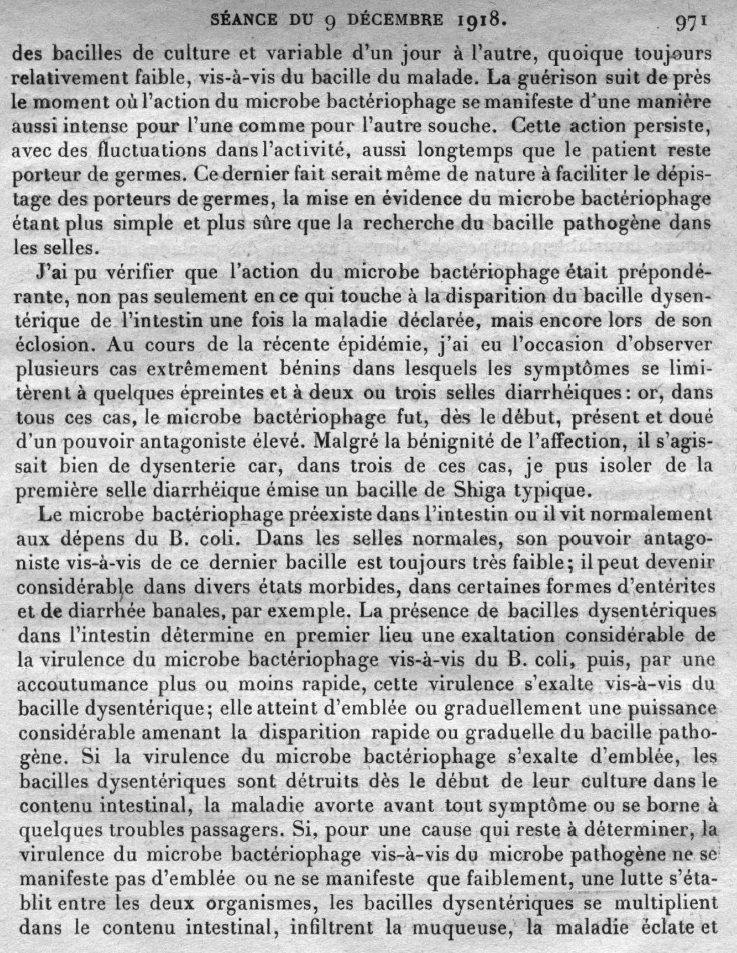
In long-term and relapsing forms, the bacteriophage power of the filtering microbe may, at certain times, be very energetic with respect to cultured bacilli and variable from one day to the next, although always relatively weak, with respect to the patient’s bacillus. Recovery closely follows the moment when the action of the bacteriophage microbe manifests itself in an equally intense manner for both strains. This action persists, with fluctuations in activity, as long as the patient remains a carrier of germs. This latter fact would even be likely to facilitate the detection of germ carriers, the detection of the bacteriophage microbe being simpler and more reliable than the search for the pathogenic bacillus in the stools.

I was able to verify that the action of the bacteriophage microbe was preponderant, not only with regard to the disappearance of the dysentery bacillus from the intestine once the disease had declared itself, but also during its outbreak. During the recent epidemic, I had the opportunity to observe several extremely mild cases in which the symptoms were limited to a few sputum and two or three diarrheal stools: now, in all these cases, the bacteriophage microbe was, from the beginning, present and endowed with a high antagonistic power. Despite the benignity of the affection, it was indeed dysentery because, in three of these cases, I was able to isolate from the first diarrheal stool emitted a typical Shiga bacillus.

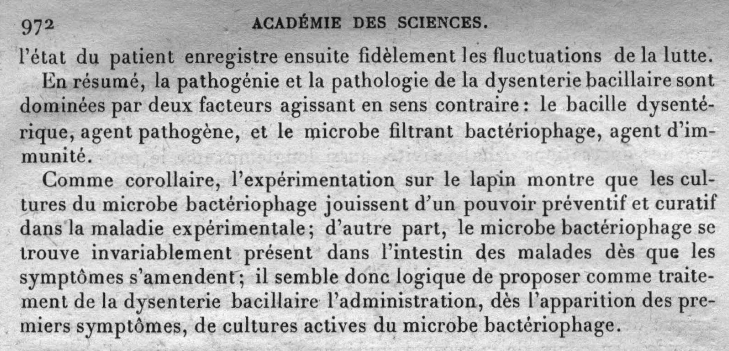
The bacteriophage microbe pre-exists in the intestine where it normally lives at the expense of B. coli. In normal stools, its antagonistic power towards the latter bacillus is always very weak; it can become considerable in various morbid states, in certain forms of enteritis and common diarrhea, for example. The presence of dysenteric bacilli in the intestine first determines a considerable exaltation of the virulence of the bacteriophage microbe towards B. coli, then, by a more or less rapid habituation, this virulence is exalted towards the dysenteric bacillus; it immediately or gradually reaches a considerable power leading to the rapid or gradual disappearance of the pathogenic bacillus. If the virulence of the bacteriophage microbe is immediately exalted [“very active”?], the dysenteric bacilli are destroyed from the start of their culture in the intestinal contents, the disease aborts before any symptoms or is limited to a few temporary disorders. If, for a cause which remains to be determined, the virulence of the bacteriophage microbe with respect to the pathogenic microbe does not manifest itself immediately or only manifests itself weakly, a fight is established between the two organisms, the dysentery bacilli multiply in the intestinal contents, infiltrate the mucous membrane, the disease breaks out and the patient’s condition then faithfully records the fluctuations in the fight. In summary, the pathogenesis and pathology of bacillary dysentery are dominated by two opposing factors: the dysentery bacillus, the pathogenic agent, and the filtering microbe bacteriophage, the agent of immunity. As a corollary, the experiment on the rabbit shows that cultures of the bacteriophage microbe have a preventive and curative power in the experimental disease; on the other hand, the bacteriophage microbe is invariably present in the intestine of the sick as soon as the symptoms improve; it therefore seems logical to propose, as a treatment for bacillary dysentery, the administration, as soon as the first symptoms appear, of active cultures of the bacteriophage microbe.

Stephen T. Abedon

Department of Microbiology – The Ohio State University

phage.org – phage-therapy.org – biologyaspoetry.org

Ambiguous Phage Terms

Stephen T. Abedon

Department of Microbiology – The Ohio State University

phage.org – phage-therapy.org – biologyaspoetry.org


All fields employ specialized terms and at a minimum it is helpful for those individuals working in a field to both know and agree upon what those terms mean. As no doubt is also the case for most or all other fields, in phage biology there are a number terms that nonetheless possess ambiguous meanings. Here I provide both a list and brief discussion of my personal top-ten list of ambiguously defined or otherwise improper phage terms. Note that in many cases it generally is good practice to be aware of and then define ambiguous terms as you use them; this is so that your reader will understand what specific meaning you may be hoping to convey. Here then, in alphabetical order, is my list of top-ten ambiguous phage terms and why I’ve placed them on the list.

  1. Adsorption – This term is not so much ambiguous as potentially covering far too much ground. It can be used to describe the entire process of phage acquisition of a host bacterium, from diffusion through collision with a bacterium, attachment, virion conformational change, and even nucleic acid translocation. Alternatively, it can just mean attachment, though even that can be reversible attachment versus irreversible. In this case actually defining your intended meaning is not necessarily important, though keeping in mind the term’s ambiguous nature can’t hurt.
  2. Capsid – Though scientifically I “grew up” considering the entire phage particle sans the nucleic acid – and sans also the envelope, if present – as the capsid, in fact the capsid can be distinguished, in tailed phages, from the tail. The capsid thus surrounds and serves to contain and protect the nucleic acid and can contrast with other proteinaceous virion appendages which have other functions such as phage delivery into the adsorbed host cell.
  3. Carrier state – Different sub-fields use this term differently. Indeed, almost everybody uses this term with different meanings. If somebody says to you, “Carrier state”, you probably will assume that the intended meaning is whatever it is that you typically think the intended meaning should be. A little piece of advice: Don’t bet large amounts of money on that assumption.
  4. Lysis from without – Lysis from without is a term that almost makes me want to cry. There generally are four definitions used for the term, two of them both correct and distinct and two of them simply are wrong. If a phage particle, particularly when applied in high densities, lyses a target bacterium and does so well prior to the normal end of that phage’s latent period, then that’s lysis from without. If an endolysin is purified and then applied to a bacterium externally, resulting in lysis, then that also is lysis from without. By contrast, if you add large numbers of phages to a bacterium and the bacterium dies, that has almost no meaning except that phages can kill bacteria. As for the fourth usage, if you observe confluent clearing in the course of a spot test, then that’s a zone of inhibition rather than necessarily lysis from without, just like the zones of inhibition that antibiotics produce. Spot formation in fact says absolutely nothing about the lytic behavior of the phage applied other than that the phage in the numbers applied, or even the carrying fluid, can appreciably kill the target bacteria.
  5. Lysogenic phage – Bacteria are lysogenic. That is, if they contain a prophage then they have the potential to generate lysis in a second bacterial strain following the mixing of cultures. What people mean to say when they say lysogenic phage is temperate phage. Lysogenic phage is ambiguous in the sense that it is a misapplied term. Please, just don’t use it.
  6. Lytic phage – So, what is a lytic phage? A phage that lyses bacteria? What kind of information does that supply? That it isn’t a chronically released phage? Is that the intended meaning when “lytic” is used as a qualifier for “phage”? Sometimes, yes it is. Usually, though, the term lytic phage seems to be used to mean non-temperate. The logic of this meaning, however, is not necessarily well worked out since most temperate phages technically are also lytic phages and temperate phages also can lyse cultures of bacteria. Traditionally, people have used the term “Virulent” to describe non-temperate, non-chronically releasing phages. I prefer obligately lytic since the term virulent as applied to phages also, technically, is ambiguous. Nevertheless, in the case of “Virulent phage” there is sufficient tradition that I’ll, at least within the context of this discussion, let this latter concern slide.
  7. Multiplicity of infection – Once upon a time people did phage experiments starting with high bacterial densities and almost all of the phages adsorbed. Thus, multiplicity of infection could be thought of as the ratio of added phages to bacteria. Some careful souls pointed out that you really do need to measure adsorption efficiency before making this claim since the real meaning of multiplicity of infection is literally multiplicity of infection, that is, the ratio of the number of successfully infecting or at least successfully adsorbing phages to the number of target bacteria that the phages had been added to. In the more modern literature, however, people started adding phages to low densities of bacteria and then claimed that this ratio of added phages to target bacteria too is the multiplicity of infection. It’s not. At best it’s the phage multiplicity of addition.
  8. Rise – OK, this one is not something that people generally have problems with since it’s rarely used. Nonetheless, this is my list and the bacteriophage rise is a concept that I care about. The rise traditionally refers to a culture’s increase in phage titer as seen over the course of single-step growth curves (a.k.a., one-step growth curves). The phage titers after a certain point literally rise, hence this is the rise. The rise is not the increase in number of phage virions found inside of bacteria prior to phage-induced bacterial lysis. So far as I know, that latter concept does not actually have a standard, well agreed upon descriptor. As the term “Rise” already exists to describe a different phenomenon, however, it should not be used also within this latter, intracellular context.
  9. Pseudolysogeny – Not only is this term used to describe a multitude of phage phenomena, for the most part we don’t have all that much of a mechanistic understanding of any of them. It is probably a really good idea, therefore, to do one’s best to avoid using this term. But if you must use it, then explicitly and unambiguously define it in terms of what pseudolysogeny means to you. I’ve personally identified literally more meanings of pseudolysogeny than I care to count; see my 2009 reference, below, so that you can count them for me.
  10. Spot versus Plaque – Spots and plaques are not the same thing and a plaque never should be called a spot even though they sort of look like tiny spots. Similarly, a spot should never be called a plaque even though they sort of look like and can even act like giant-sized plaques. The distinction? A plaque is initiated with a single infective center, that is, approximately a point source of subsequent phage production. A spot is initiated with multiple infective centers, that is, multiple point sources of potential phage production that converge into a single zone of clearing. In addition, while plaque formation is absolutely dependent on productive phage infections (those infections that produce phage virions), a spot can form solely by killing bacteria, i.e., without also producing phage progeny.

And here’s a bonus term: Abortive infection. Just so that everybody is on the same page, the ability of some phages under some conditions to form spots without also producing new phages is a consequence of phages killing bacteria without also going through a normal infection cycle. That is, an abortive infection. Confusingly, lysis from without, in its original meaning (i.e., as listed first, above) is a form of abortive infection. Even more confusing, the means by which abortive infections are assayed, using measurements of what is known as efficiency of plating, can include not just phages that kill bacteria without also producing new phages but also phages that kill bacteria while producing new phages but not, under the same conditions, enough new phages to also produce plaques. I describe the latter as a “Reduced infection vigor”. Ecologically that distinction is an important one but more important is to realize that there exist numerous examples of phages killing bacteria without necessarily also vigorously producing new phages.

Presumably there are additional ambiguous phage terms out there and if I thought about it further, then I probably could ID a few more as well. Others also will have their own personal pet peeves which they too might consider blogging about. In any case, don’t forget that it can be helpful to define your terms as you use them. Done properly, then your audience will know what you mean. Your meaning might not be their meaning, but in theory at least nobody can complain if you explicitly explain exactly what it is that you are trying to say.

Further reading:

Abedon, S. T. (2009). Disambiguating Bacteriophage Pseudolysogeny: An Historical Analysis of Lysogeny, Pseudolysogeny, and the Phage Carrier State. In: Contemporary Trends in Bacteriophage Research. Adams, H. T. (ed), Nova Science Publishers, Hauppauge, New York, 285-307

Abedon, S. T. (2011). Lysis from Without. Bacteriophage 1(1):46-49. [PubMed link]

Hyman, P., Abedon, S. T. (2009). Practical Methods for Determining Phage Growth Parameters. Methods in Molecular Biology 501:175-202. [PubMed link] (for consideration of the phage multiplicity of infection and rise)

Hyman, P., Abedon, S. T. (2010). Bacteriophage Host Range and Bacterial Resistance. Advances in Applied Microbiology 70:217-248. [PubMed link] (for consideration of abortive infections)

See also the terms list found in phage.org.

Phage Therapy Case Study from 1936

Stephen T. Abedon

Department of Microbiology – The Ohio State University

phage.org – phage-therapy.org – biologyaspoetry.org


This article can’t be found via a PubMed search but can be found here: jama.jamanetwork.com/article.aspx?articleid=1156439. It is not free, but most of it can be found on that page. The reference is Morrison, S., Gardner, R.E. (1936). The Treatment of a Lung Abscess due to Bacillus coli with a Lytic Filtrate. JAMA 107(1):33-34. It is a fascinating account because it walks you through the case in some detail plus presents both efficacy and side effects, neither of which can be unquestionably attributed to the phage itself since the formulation used was not purified. Still, pretty amazing stuff, and I quote:

N, S., a woman, aged 22, who had previously been in excellent health, suddenly experienced a severe diffuse abdominal pain, Aug. 5, 1934… On the third day the patient’s condition became critical and she was rushed to the Chambersburg (Pa.) Hospital, where an emergency operation was performed by Dr. L. H. Seaton. When the abdomen was opened a gangrenous appendix with generalized peritonitis was disclosed. The remainder of the appendix was removed and drains were inserted…

[Approximately one month later,] after an excruciating pain, examination disclosed massive collapse of the left lung. During the subsequent few days slight signs of partial return of pulmonary function were observed, but relapse followed. Clinical and x-ray signs of effusion developed. Aspiration was performed September 12 and 500 cc. of very heavy purulent material with a foul and typical colon odor was obtained. A culture of the pus at this time yielded only Bacillus coli. Three days later, because the material was too thick to be aspirated, rib resection was done with a virtual gush of pus. A bronchial fistula developed shortly after the rib resection and the patient was expectorat¬ ing the same kind of material as that which drained from the resection wound. The appearance of the area around the resection opening was necrotic and “mossy” and failed to show any improvement on local irrigations with 1,000 cc. of saline solution twice a day. Digital examination through the resection wound disclosed many walled off abscesses surrounded by necrotic tissue. In view of the hectic fever and the general condition, which indicated toxic absorption, an especially resistant abscess which failed to open was incised by an approach between the ribs just above the rib resection. A drain was inserted and in a few days healing took place.

A second sample of pus was collected at this time (September 16) and another pure culture of colon bacillus isolated which was fairly readily lysed by a bacteriophage that was active against various strains of B. coli isolated from other sources.

After a cutaneous test September 20 of 0.1 cc. of the lytic filtrate twelve hours previously had given little or no reaction, and after irrigating the chest with 1 liter of physiologic solution of sodium chloride, 1 ounce (30 cc.) of the phage was instilled and allowed to remain for two hours. This was followed saline irrigation and the wound covered by a dressing saturated with the bacteriophage. The following day the observation was made that the discharge had become thin and watery and had lost its offensive character for the first time since the resection was done five days before, even though saline irrigations had been administered twice daily during this five day period. A second and equally remarkable change had occurred at the resection wound itself, where the mossy, necrotic character was entirely changed to a clean, fresh, healthy appearing incision.

Since the first use of bacteriophage had given such excellent results, a second application seemed indicated, and therefore the procedure was repeated. However, within ten minutes a violent generalized rose-colored urticaria appeared and the patient complained of nausea and vomited. The bacteriophage was drained immediately and the chest irrigated with large quantities of saline solution. Epinephrine was administered…

After such a marked allergic reaction to the bacteriophage had occurred it was decided to discontinue bacteriophage instillations and continue only with saline irrigations and external dressings saturated with bacteriophage. The dressings of bacteriophage were continued for a week along with irrigations of physiologic solution of sodium chloride. Throughout this period the resection wound maintained its healthy normal appearance and the discharge remained clear, watery and nonodorous. The temperature reached 102.2 F. each day for the thirteen days prior to the urticarial reaction. On that day the reading was 103.2 F. after the reaction. After this reaction the temperature did not go above 102.2 F.

The patient’s general condition was remarkably improved and within six weeks she was able to leave the hospital. The appendiceal wound had healed but the fever, less hectic in type, continued as well as the thin nonodorous drainage. At home the fever gradually subsided as well as the drainage, and heal¬ ing was practically complete toward the end of December.

Whether the bacteriophage acted as a specific or indirectly as a Synergist to antibody formation cannot be stated.

Thus, no proof of explicitly phage-mediated efficacy, no proof that the condition would not have spontaneously reversed on its own, and no controls, but instead a remarkable result, with an indication as well of reason for caution regarding potential immunological reactions perhaps associated with the lack of formulation purification. Interesting indeed!

A Quote or Two from Hoeflmayr (1963): “Inhalation Therapy Using Bacteriophages in Therapy-Resistant Infections”

Stephen T. Abedon

Department of Microbiology – The Ohio State University

phage.org – phage-therapy.org – biologyaspoetry.org


I just came across this “report”, which can be found here:

http://www.dtic.mil/cgi-bin/GetTRDoc?Location=U-2&docGetTRDoc.pdf&AD=AD0837021

This dates from 1963, I believe as a translation, and the full citation is “Inhalation Therapy Using Bacteriophages in Therapy-Resistant Infections”. Fortschritte der Biologischen Aerosol-Forschung-Jahren 1957-1961 (Progress of the Biological Aerosol Research-Years 1957-1961), pp. 403-409. See under “Further reading” for what presumably is the original and/or complete citation.

At any rate, this paper/chapter/publication/translation/report has some interesting passages.

In view of the growing resistance against antibiotics, it is vitally important that we try to find ways to counteract this development. … Farsighted clinicians warned us as long as 10 years ago, when we were still students, that we should not hastily treat any little infection with penicillin.
If we should discover any-new possibilities for treating infections, then we should look at these possibilities only from the angle that such a therapy would have to preclude the formation of resistance as much as possible, therapy with bacteriophages fills the requirement. The fact that this therapy has so far met with skepticism is due to the results which, until a few years ago, did not ome up to expectations
[Schaefer, W., “Contribution on Epidemic Control” Vol. 3, Hippocrates, Stuttgart, 1948]. If we try to track down the reason for the failure of the earlier bacteriophage therapy, we will find that this was mostly due to the biological properties of the phages.
Now it is important to know that the bacteriophage has high specificity. Therefore, therapy can be effective
only If the administered phage encounters its homologous bacterium.
The disadvantage of our earlier phage preparations was to be found not only in the inadequate breeding methods but above all in the fact that only about 1-2 phage strains were available. If we consider the large number of pathogenic bacteria strains, which play a role even in a very simple infection or which at least at times might play a role, then we would have to set up two requirements. First of all, in order to have a wide range of effectiveness, such a therapeutic substance would have to contain a large number of various phage strains. Second, it is necessary that phages which would come into consideration for therapy should have sufficient virulence with regard to pathogenic viruses.
We used the preparation (Diriphagen ® Dr. Heinz Haury Chemical Plant, Munich) because we believed that this preparation met the requirements we just set up. According to Information received, this reparation contains 180-200 different phage strains and thus has a broad spectrum of effectiveness. In addition, it also contains so-called aimed antimicrobics which act against those bacteria that reveal primary phage resistance. We might note here that both the phage components and the added microbics in every ampule are standardized and meet the requirements for biological standardisation as regards phage effect [Penso, G., and Ortali, V., Arch. belges Med. Soc., 1, 1959]. If we mention the two therapeutic components, that is the bacteriphages and aimed (directed) antimicrobics, we are really not fully describing the effects mechanism as such. We have a third factor here. What we are dealing with here is the stimulation of the inherent defenses of the body which are bound to be aroused and which are based on the following: In breeding phages and antimicrobics, the pathogenic microbes used for this purpose give rise to lysates. But these lysates are not eliminated; instead they are also fed into the body. They act like antigens and lead to the formation of antibodies which in turn are specifically directed against the bacteria to which lyntes were added [Glauser, H. A., Med. achr., 13, 420, 1959.]. This reaction requires a latency period of about 8-10 days. The value of this antibody formation is hard to estimate in the individual case. We can get some specific figures on this only if we determine the phagocytosis capability; but this must be done in the clinic. Any new therapy is very often impaired by the fact that we do not employ it until other, more familiar measures have failed. We must admlt that we did not use Deriphagen until we had some patients in whom other preparations had not produced success. This is further by reports from other authors who achieved surprisingly good results with this preparation [Cevey, M., Schweiz. Z. Tuberk. (Swiss Tuberculosis Joural),
15, 34, 1958; Corbelli, G., Bologna Med., 6, 57, 1959; Delacoste, P., Rev. suisse Med., August 1959; Schaefer, W., “Contribution on Epidemic Control” Vol. 3, Hippoprates, Stuttgart, 1948].

Figure 1 shows the result of our treatment. The first column shows the total number of all patients treated; then we have the number of patients cured which abounted to 55.1%; then we cow to those who showed substantial improvement and on the right we have those patients who did not improve as a result of therapy [34.8%].

The author notes, however, that there is a discrepancy between microbiological and clinical results. That is, patients apparently reported a return to healthfulness but this did not coincide with elimination of pathogen, which the author seems to suggest is a consequence of phage- resistant forms not being pathogenic.

The text in the PDF then essentially fades away, though the main text of the paper continues on for two more pages!

Further reading:

Hoeflmayr, J. (1962). Inhalationstherapie mit Bakteriophagen bei therapieresistenten Infektionen [Inhalation Therapy with Bacteriophages for Treatment-Resistant Infections]. Fortschritte der biologischen Aerosol-Forschung in den Jahren 1957–1961 [Advances in Biological Aerosols Research in the Years 1957–1961].  403-409. 1962. (I believe this is the original reference)

Abedon, S. T., Kuhl, S., Blasdel, R., Kutter, E. M. (2011). Phage Treatment of Human Infections. Bacteriophage 1(2): 66-85. [PubMed link] (this article provides further historical context on European use of phage therapy, though note that description of a German tradition in that article is completely lacking and so far as I am aware was unknown to the authors at the time of its writing)

Bacteriophages, Spatial Structure, and the Joys and Limitations of a Swiss Pass

Stephen T. Abedon

Department of Microbiology – The Ohio State University

phage.org – phage-therapy.org – biologyaspoetry.org

(This essay was written while touring Switzerland by train, July, 2014)


Travel can be joyous but also can involve a lot of work. The basic premise of travel is movement, whether specifically from one destination to another or instead something more random. In either case it takes time for you to move from that one place to another. Even the exploration of a smallish country therefore can take enormous amounts of time, since each of numerous legs of your journey will take some amount of time to traverse. You can purchase a Swiss Pass, and explore much of Switzerland over days and even weeks. You’ll see a lot, but you certainly will see far from everything. These temporal delays that are manifest as you travel are one of things that makes traveling difficult, but at the same time this relative slowness can be what makes a journey worthwhile. If you flittered from place to place at the speed of light, never pausing, you would touch upon much more, but your experience would be far different. Indeed, there are qualitative differences between your experiences as you fly, drive, take a train, ride a motorcycle, ride a bike, walk, or indeed not move at all.

Spatial structure is a property of environments in which delays in movement exist. If you can instantaneously and randomly be anywhere, then there is no spatial structure. In microbiology, spatial structure is seen especially under circumstances that do not substantially involve turbulent flow. When you shake a broth-filled flask, one of the consequences of that action is to reduce spatial structure. In terms of interactions between predators and prey, of bacteriophages and bacteria, the result is that any one individual may interact with any other individual with equivalent probability. If you replace any collision between phages and bacteria with the special kind of interaction that is sex, then you have random mating. If you replace any collision with the special kind of interaction that is phage infection of bacteria, then you have random infection. Either case is implicitly a consequence of a lack of spatial structure in the environment.

Spatial structure generally is what happens within environments almost no matter what. You can strive to remove spatial structure, such as via the shaking or stirring of broth, but absent such measures, or indeed if volumes are large enough and mixing slow enough, then some spatial structure nonetheless will be retained. A static microcosm – where the mixing of broth is reduced essentially to zero and therefore where movement is dominated by either motility or diffusion – thus can represent a spatially structured environment. More obvious is the spatial structure that occurs when movement is reduced even further, as is the case with the addition to environments of various thickening agents such as agar.

In phage biology the classic laboratory-observed consequence of spatial structure is the formation of phage plaques, which are clearings within otherwise turbid bacterial cultures, ones that have been spread or poured onto agar plates. The formation of a plaque requires three processes: phage population growth, phage-mediated reduction of bacterial densities, and, crucially, limitations in phage as well as bacterial movement.  Generally a plaque begins with a single plaque forming unit (PFU) which consists of an infective center and in turn can be either an individual phage virion, a clump of phage virions, a phage-infected bacterium, or a clump of bacteria at least one of which is phage infected. This infective center serves as a point source for the outward but nonetheless slow diffusion of phage virions away from their origin. The movement is outward only because the random process of diffusion tends to result in a broadening of the “cloud” of diffusing particles. Because of limitations on the rate of this movement, however, the cloud remains relatively small: the confluent lysis of an entire plate via the growth of a single plaque generally does not occur.

The phage is you. You can start a family and outfit each member of your family with a Swiss Pass. But unless your explorations of the amazing beauty that is Switzerland occurs over extremely long periods, then your and your family’s potential to see all of Switzerland will be relatively limited. This is less true, however, if your family is very large, so large that at least one family member is present to explore each place that may be explored. In this case complete exploration of a discrete area may be achieved. Your ability to explore broader areas nevertheless will be limited at least in part by how long it takes you or your family to get there.

Further reading:

Abedon, S. T., Bartom, E. (2013). Plaques. Brenner’s Encyclopedia of Genetics. Maloy, S., Hughes, K. (eds). Academic Press, pp. 357-357.

Abedon, S. T., Yin, J. (2009). Bacteriophage Plaques: Theory and Analysis. Methods in Molecular Biology 501:161-174. [PubMed link]

Abedon, S. T., Yin, J. (2008). Impact of Spatial Structure on Phage Population Growth. In: Bacteriophage Ecology, Abedon, S. T. (ed), Cambridge University Press, Cambridge, pp. 94-113.

For videos of my explorations of Switzerland, as well as other aspects of my existence, see youtube.com/channel/UCf0uLeBfCToHT3eAoYFmcNA.