Phages vs. Potato Soft Rot

Stephen T. Abedon

Department of Microbiology – The Ohio State University

phage.org – phage-therapy.org – biologyaspoetry.org


Here’s an interesting news item, from only a couple of years back (April 4, 2013): “Taking a greener approach to managing potato spoilage”

http://www.farmersguardian.com/home/arable/arable-news/taking-a-greener-approach-to-managing-potato-spoilage/54554.article

Here are some quotes:

The innovative, eco-friendly product is called Biolyse and works by using naturally-occurring bacteriophage

APS chief executive Dr Alison Blackwell says now the product is proven to work on a large scale in potatoes, there is potential for it to be rolled out to other areas within the food processing industry.

Dundee-based APS has been developing bacteriophage since 2004.

Three years ago, APS received a Scottish Enterprise Research and Development grant and was then able to work closely with a team from Branston’s Abernethy site in Perthshire, Scotland, to identify the bacteria causing rots and develop a suitable bacteriophage.

Biolyse was launched in the Abernethy factory in November 2011 and rolled out across Branston’s other two sites in Lincolnshire and Somerset in 2012. The product is also used by QV Foods and Albert Bartlett.

There is a consistent five to tenfold reduction in rots pre and post bacteriophage treatment.

Installing the application equipment for Biolyse cost about £10,000 and was fairly simple, according to Kevin Imrie, site manager at Abernethy.

Anybody have any idea how this product currently is doing?

Here is APS Biocontrol’s web site: http://www.advancedpestsolutions.co.uk/

Further reading:

T4-related bacteriophage LIMEstone isolates for the control of soft rot on potato caused by ‘Dickeya solani’

Phage-Mediated Biocontrol of Plant Pathogens (2001 to “current”)

Phage therapy for plant disease control

Bacteriophage Ecology and Plants


E. coli, CRISPR, Biases in Our Understanding of Phage Ecology, and Possible Implications for Phage Therapy

Stephen T. Abedon

Department of Microbiology – The Ohio State University

phage.org – phage-therapy.org – biologyaspoetry.org


We’re all biased by what we know best and the link below discusses why, historically as well as microbiologically, we all “grew up” with the notion that envelope mutations are the primary means by which phage resistance evolves in bacteria. So thank you E. coli (I state with sarcasm):

http://schaechter.asmblog.org/schaechter/2014/11/why-crispr-doesnt-work-in-.html

What, I ask, are the implications for phage therapy of resistance mechanisms to specific phages that are essentially cost free and, at least arguably, Lamarckian as well, i.e., as due to CRISPR? For well-trained phage-therapy teams, I suspect not much. This is because, whether employing cocktails or monophages, the intention generally will be to hit bacterial targets hard and with whatever it takes to clear the infection, such as to switching phages during monophage therapy if resistance is noted.

But for monophages in the hands of less well-trained individuals, e.g., over-the-counter phage formulations or in the hands of poorly trained or regulated clinicians, the potential for development and then transmission of fully fit pathogens that nonetheless are fully resistant to a specific monophage could be fairly high. Importantly, and as relevant to the cited E. coi-CRISPR story, this issue may be more relevant for some pathogens, i.e., those with intact CRISPR systems, than it is for others.

So perhaps we can add inhibition of the potential for therapy-induced evolution of phage resistance among pathogens – as could then be transmitted across affected human communities – as an additional advantage of  prêt-à-porter (phage cocktails) versus sur-mesure (monophage therapy), while still retaining an argument for sur-mesure particularly among highly experienced phage therapists.

As we note in Chan and Abedon (2012), I nevertheless don’t buy arguments that spontaneously occurring phage host range mutations can be counted on in situ to counter bacterial evolution to phage resistance whether in the context of phage cocktails or instead monotherapy. From p. 19 of that publication:

A further consideration is that just as cocktails of phages may be thwarted in their ability to target low densities of phage-resistant bacteria, particularly given active treatment, these concerns should be even greater if one is relying on in situ phage evolution to supply resistance-countering phages… The reason for this is that the necessary host-range mutant phage types will be present in even lower densities than the phages explicitly found in cocktails. These same concerns may also be seen even in the absence of spatial structure so long as those phages within a cocktail that are amplified in situ, that is, in the course of active treatment, are not the same phages to which bacterial phage-resistant mutants are sensitive… Active therapy even with phage cocktails thus may be inherently incompatible with early interference with the evolution of bacterial resistance to phages.


Phage cocktails nevertheless should be better suited than monophages for dealing with evolving bacterial resistance to phages simply because cocktails inherently possess greater total numbers of phage particles that display divergent host ranges. On the other hand, the generation of cocktails of phages that display divergent host ranges – but where those phages nevertheless have been derived from a common genetic “platform” – might be expected to perform little better than monophages in the face of CRISPR-mediated phage resistance in target bacteria.

Further (Phage Therapy) Reading:

Chan, B. K., S. T. Abedon, and C. Loc-Carrillo. 2013. Phage cocktails and the future of phage therapy. Future.Microbiol. 8:769-783. [PubMed]

Chan, B. K. and S. T. Abedon. 2012. Phage therapy pharmacology: phage cocktails. Adv.Appl.Microbiol.  78:1-23. [PubMed]

Pirnay, J. P., V. D. De, G. Verbeken, M. Merabishvili, N. Chanishvili, M. Vaneechoutte, M. Zizi, G. Laire, R. Lavigne, I. Huys, G. Van den Mooter, A. Buckling, L. Debarbieux, F. Pouillot, J. Azeredo, E. Kutter, A. Dublanchet, A. Gorski, and R. Adamia. 2011. The phage therapy paradigm: prêt-à-porter or sur-mesure? Pharm.Res 28:934-937. [PubMed]

Importance of Specificity

Stephen T. Abedon

Department of Microbiology – The Ohio State University

phage.org – phage-therapy.org – biologyaspoetry.org


This article is not yet fully out but certainly is intriguing: http://www.cell.com/cell/abstract/S0092-8674(15)00003-3

The title is “Disease-Specific Alterations in the Enteric Virome in Inflammatory Bowel Disease” by Norman et al.

The basic premise is that phages may very well be knocking out beneficial bacteria, in the gut, resulting in disease.

Here is a synopsis: https://www.sciencenews.org/article/when-bacteria-killing-viruses-take-over-it%E2%80%99s-bad-news-gut

To me what’s particularly interesting about this study, what little currently can be easily accessed, is that it actually can be viewed as an argument for the benefits of phage specificity in the guise of phage-mediated biocontrol of bacteria, i.e., phage therapy as applied clinically.

Specifically (if you will pardon the pun), when phages are employed in phage therapy, there is at best an only low potential that beneficial bacteria will be directly affected because phage host ranges tend to be quite narrow, typically at best spanning a single bacterial species and potentially some members of closely related genera. This contrasts with the typical antibiotic, which can be much less discriminatory in its impact on normal microflora, potentially resulting in bacterial superinfections.

Indeed, some antibiotics even can induce prophages, resulting in antibiotics potentially giving rise to excessive phage numbers that can impact beneficial bacteria. It is even possible for antibiotics to have an indirect impact by killing off certain bacteria that might then allow an overgrowth of beneficial bacteria which in turn could result in an achievement of so-called “winner” densities. Excessively high densities of specific bacterial types may then be followed by phage-induced reductions in the presence of these beneficial bacteria to below those levels present prior to antibiotic exposure (and then potentially overgrowth of harmful bacteria).

Sure these scenarios are complex and the latter certainly speculative. But the bottom line nonetheless is this: Some phages are bad – and we know this already since many phages carry bacterial virulence factor genes – but not all phages are bad, and those phages that are good in many or most instances probably give rise to somewhat less negative impact on the body than the majority of antibiotics.

Celebrate the diversity of phages, and their specificity!

Another layer of understanding to add to the genome injection story

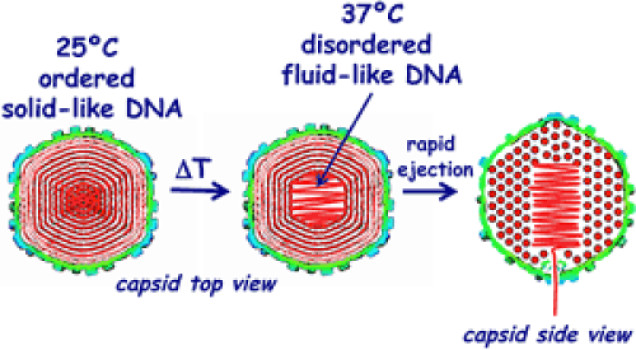
Releasing the packaged viral DNA into the host cell is an essential process to initiate viral infection. In many double-stranded DNA bacterial viruses and herpesviruses, the tightly packaged genome is hexagonally ordered and stressed in the protein shell, called the capsid. DNA condensed in this state inside viral capsids has been shown to be trapped in a glassy state, with restricted molecular motion in vitro. This limited intracapsid DNA mobility is caused by the sliding friction between closely packaged DNA strands, as a result of the repulsive interactions between the negative charges on the DNA helices. It had been unclear how this rigid crystalline structure of the viral genome rapidly ejects from the capsid, reaching rates of 60,000 bp/s. Through a combination of single-molecule and bulk techniques, we determined how the structure and energy of the encapsidated DNA in phage λ regulates the mobility required for its ejection. Our data show that packaged λ-DNA undergoes a solid-to-fluid–like disordering transition as a function of temperature, resulting locally in less densely packed DNA, reducing DNA–DNA repulsions. This process leads to a significant increase in genome mobility or fluidity, which facilitates genome release at temperatures close to that of viral infection (37 °C), suggesting a remarkable physical adaptation of bacterial viruses to the environment ofEscherichia coli cells in a human host.

Significance

The efficiency of viral replication is limited by the ability of the virus to eject its genome into a cell. We discovered a fundamentally important mechanism for translocation of viral genomes into cells. For the first time, to our knowledge, we show that tightly packaged DNA in the viral capsid of a bacterial virus (phage λ) undergoes a solid-to-fluid–like structural transition that facilitates infection close to 37 °C. Our finding shows a remarkable physical adaptation of bacterial viruses to the environment of Escherichia coli cells in a human host.

In the beginning…

Young_d'Herelle“From a modern microbiological viewpoint the motivation behind the experiments that led to the discovery of bacteriophage is hard to understand. What was the purpose of filtering a bacterial culture to remove the bacteria, then remixing the filtrate with a fresh bacterial culture? We all know the outcome of this classic experiment, but why was it done in the first place? To fathom the intent of the original investigator, Félix d’Herelle, one has to put aside twenty-first century ideas and recover the context of microbiology and disease in the early twentieth century.
Phage-Mediated Biocontrol of Plant Pathogens (2001 to “current”)

Stephen T. Abedon

Department of Microbiology – The Ohio State University

phage.org – phage-therapy.org – biologyaspoetry.org


I gave the opening talk at the 2nd International Symposium, “New Stages of Phage Biocontrol of Plant Diseases”, held September 18, 2014, at Hiroshima University, Japan. Though my talk was at best peripheral to the emphasis of the symposium, i.e., watch here, I did strive to get into the spirit of things by tracking down references to phage-mediated biocontrol of plant pathogens. Clearly I did not succeed in finding every last one of these references, but nevertheless I probably IDed the ones that “everybody” in the field knows about, and maybe perhaps then some. I’ve sorted these by year plus have indicated the target pathogen as well as the disease that is caused by that pathogen. Where possible I’ve provided a link to the article, though note that I’m providing no promises regarding your potential to find all of these articles online for free! Shown only are experimental articles, and note that I have not confirmed the validity of many of these. So if you know better, or can otherwise help by adding to this list, please let me know!

Here are those papers published in the Twenty-First Century (2001 and newer) up to at least the date of my talk:

Continue reading

Going Bottomless in the Plaque World

Stephen T. Abedon

Department of Microbiology – The Ohio State University

phage.org – phage-therapy.org – biologyaspoetry.org


Bottom agar = Hard agar = Solid media

Top agar = Soft agar = Sloppy agar = Semi-Solid media.

I’m embarrassed to say that I’ve had this article in my reference database since August of 2007: Rizvi, S., Mora, P.T. (1963). Bacteriophage plaque-count assay and confluent lysis on plates without bottom agar layer. Nature 200:1324-1325. It is only today, however, and apparently as a form of avoidance behavior (there’s a talk I’m supposed to be working on), that I’ve obtained the reprint and set out to read it.

Their second sentence reads, “Having spent considerable time on preparation of ‘bottom’ agar plates for the agar layer assay by the plaque count method and for high-titre bacteriophage stock preparation on a large number of plates by the confluent lysis method…” And thus they are off striving to do something about this by investigating “…the possibility of saving time by using plates without ‘bottom’ agar for assay and stock preparation.”

The media they used for their ‘bottomless’ agar consisted of the following:

  • 10 g Difco bacto-casamino-acids (acid hydrolysed casein)
  • 15 g Difco bacto-nutrient broth
  • 10 g Sucrose
  • 1g Dextrose
  • 5g Crystalline magnesium sulphate
  • 5 g Sodium chloride
  • 8g Agar

Efficiencies of plating in testing phages T1 through T7 they found to be essentially 100% for T1, T3, and T7, and basically 50% for the rest. To the extent that my interpretation of the ‘smudges’ provided in Nature’s PDF can be trusted, the per plate yields for confluent lysis phage preps were more or less the same with versus without bottom agar. Consistently for the latter they note: “The yields obtained on plates without ‘bottom’ agar were slightly better than the yields obtained on plates with ‘bottom’ agar.”

They also note that, “Confluent lysis can be adapted for large-scale bacteriophage production by carrying it out on large stainless steel trays.”

Historical Referencing:

These authors also cite four, mostly Mark Adams-dominated publications for plaque count method (first three) and confluent lysis stock preparation (last). These are:

(1) Gratia, A. (1936). Des relations numeriques entre bactéries lysogenes et particules de bacteriophage. Ann. Inst. Pasteur, 57:652-676.

(2) Adams, M. H. (1950). Methods of Study of Bacterial Viruses. (Methods in Medical Research, 2:1) The Year Book Publishers, Inc., Chicago.

(3) Adams, M. H. (1959). Bacteriophages. Interscience Publishers, Inc., New York.

(4) Swanstrom, M., and Adams, M. H. (1951). Agar layer method for production of high titer stocks. Proc. Soc. Exp. Biol. and Med. 78:372-375.

GOT (phages in your breast) MILK?

Whether it be the suckling newborn, trend-following athlete, or odd lactophile, human breast milk consumers are ingesting more than just calcium and protein in their morning bottle (or shake). Aside from the complete panel of nutritional components and immune boosters that breast milk offers, –proteins, sugars, fats, vitamins, fatty acids, enzymes, antibodies, and leukocytes – it also creates a gulf stream for the vertical transmission of bacteria from the producer to the intestinal tract of the consumer. And where there are bacteria, phage is sure to follow.

Jeremy Barr and the Rowher group are investigating the mother-to-infant transmission of phages in breast milk, and more specifically, what role phages may play in intestinal mucosal immunity.

At the Viruses of Microbes conference last July in Zurich, Barr presented data on the detection Virus-Like-Particles (VLPs) in breast milk samples from five different women. VLPs selected for cesium-chloride density, chloroform resistance, particle size, and dsDNA fluorescence were found from 103 – 104 VLP/mL in each samples, showing that, indeed, phages are present in breast milk.

They are currently investigating what types of phages are actually present by sequencing of the human breast milk virome of mothers, and corresponding stool samples from their breast milk-drinking babies.

While waiting for the answer as to “who” is present in breast milk, they have already starting probing the question of the potential role of phages at their final destination: the infant intestinal tract. To test the ability of phage to adhere and remain in the intestinal tract, T4 phage was mixed with human breast milk, infant formula, or buffer at 107 PFU/mL and layered onto mucus-producing gut epithelial cells. Significantly higher amounts of phage mixed with real milk were recovered after washing and scraping gut cells than for formula- or buffer- phage solutions. This increase, however, was accrued in a in a lactation stage-dependent fashion, with early stage milk supporting greater phage adherence.

So, phages are present in human breast milk and, when coupled with milk, they can persist at the intestinal mucosal surface, but do they have an effect on infection? The first step in the establishment of bacterial infections is bacterial adherence to host epithelial receptors, and breast milk alone contains oligosaccharides that have been shown to prevent mucosal adhesion of such unwanted, disease-causing bacteria or viruses (Bode, 2012). When epithelial cells were cells pre-incubated with phage in breast milk prior to infection with Escherichia coli, significantly fewer bacteria were able to adhere to the host cell surface as compared to only breast milk, or phage-treated formula or buffer.

Clearly, mother’s milk has something that formula has yet to fit into a can.


…Keep an eye out for an upcoming publication that will detail the specific components of human breast milk that are necessary for this phage-mucosal interaction, as well as for human breast milk virome!

VoM, Zurich, 2014 “Bacteriophage in human breast milk provide infant mucosal immunity.” Information presented by Jeremy Barr, PhD

Phages & Flamingos

For my first post on this blog, I wanted to share the following paper with you, The virus’s tooth: cyanophages affect an African flamingo population in a bottom-up cascade (see below). It captured my attention after Dr. Brian Jones visited my lab earlier in 2014 where he gave a lecture on flamingos in Kenya (Lesser Flamingo, Phoeniconaias minor). As an extremophile specialist he had been invited to a workshop organized by the Kenyan government to find out why the flamingos have disappeared from Lake Nakuru, a local alkaline lake. According to Brian, many theories were offered up during the workshop, but none of them with sufficient evidence, mainly because of a lack of long-term monitoring of the lakes’ ecosystem.

The following paper presents a possible explanation: Phages caused it! The researchers hypothesize that cyanophages are at the root of a bottom-up cascade causing the flamingo’s main food source, the cyanobacterium Arthrospira fusiformis, to be broken down causing massive drops in flamingo numbers. 

A question of where did the flamingos go, was partly answered accidently at a sampling expedition of my lab, the Centre for Microbial Ecology and Genomics (CMEG, University of Pretoria). Each year a bunch of researchers of CMEG and collaborators make a trip to the Namib Desert to investigate the local arid ecosystems. When driving to the closest town, Walvis Bay, about a 90 minute away located at the Atlantic Ocean, many people stop at the actual bay to watch huge gatherings of the Lesser Flamingo. Sadly, we have no records of how many years the flamingos have been gathering there and if there stay there year-round or not.


The virus’s tooth: cyanophages affect an African flamingo population in a bottom-up cascade

Link to the article

ABSTRACT

Trophic cascade effects occur when a food web is disrupted by loss or significant reduction of one or more of its members. In East African Rift Valley lakes, the Lesser Flamingo is on top of a short food chain. At irregular intervals, the dominance of their most important food source, the cyanobacterium Arthrospira fusiformis, is interrupted. Bacteriophages are known as potentially controlling photoautotrophic bacterioplankton. In Lake Nakuru (Kenya), we found the highest abundance of suspended viruses ever recorded in a natural aquatic system. We document that cyanophage infection and the related breakdown of A. fusiformis biomass led to a dramatic reduction in flamingo abundance. This documents that virus infection at the very base of a food chain can affect, in a bottom-up cascade, the distribution of end consumers. We anticipate this as an important example for virus-mediated cascading effects, potentially occurring also in various other aquatic food webs. 


An M13 phage based colorometric sensor

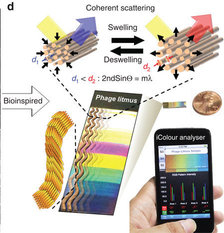
Having previously demonstrated the ability to build collagen-like self-templating supramolecular structures out of M13 phage filaments, this year the Seung-Wuk Lee Lab has come out with a new paper demonstrating their ability to use those structures as a litmus to sensitively detect things like humidity, volatile organic compounds, or TNT explosives and report color strongly enough for an iPhone camera to distinguish:

Biomimetic virus-based colourimetric sensors
Many materials in nature change colours in response to stimuli, making them attractive for use as sensor platform. However, both natural materials and their synthetic analogues lack selectivity towards specific chemicals, and introducing such selectivity remains a challenge. Here we report the self-assembly of genetically engineered viruses (M13 phage) into target-specific, colourimetric biosensors. The sensors are composed of phage-bundle nanostructures and exhibit viewing-angle independent colour, similar to collagen structures in turkey skin. On exposure to various volatile organic chemicals, the structures rapidly swell and undergo distinct colour changes. Furthermore, sensors composed of phage displaying trinitrotoluene (TNT)-binding peptide motifs identified from a phage display selectively distinguish TNT down to 300 p.p.b. over similarly structured chemicals. Our tunable, colourimetric sensors can be useful for the detection of a variety of harmful toxicants and pathogens to protect human health and national security.

rsz_1ncomms4043-f1
“Bioinspired phage-based colourimetric sensors, termed Phage litmus, are composed of hierarchical bundles like the collagen fibres in turkey skins. Application of target molecules (chemical stimuli) causes colour shifts due to structural changes, such as bundle spacing (d1 and d2) and coherent scattering. Using a handheld device’s camera (iPhone) and home-built software (iColour Analyser), we can identify target molecules in a selective and sensitive manner.”